haecksathon #7
Opening notes
Agenda
- Short language history
- A descriptive take
- Language introduction
- Practice
Language history
Python started as a successor to ABC in 1998.
It’s named after Monty Python’s Flying Circus.
The dictator

Guido van Rossum in 2014, source

- Benevolent dictator for life (1995 - 2018)
Logo 1990 - 2006
Logo 2006 - present
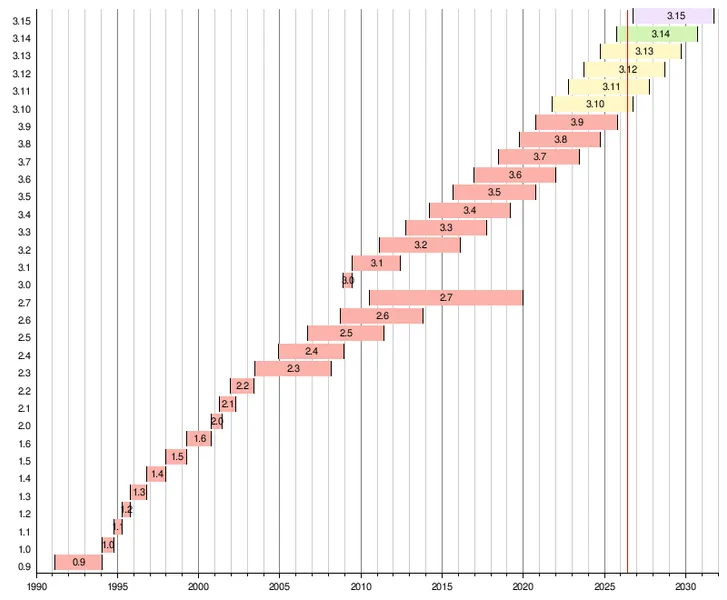
Python 3 is a bit of a story
2.7 -> 3.0
Language influences
- Multi-paradigm, leaning towards object orientation
- ABC: syntax
- Haskell, Standard ML:
itertools,functools- list-, set-, dictionary- comprehensions
A Descriptive take
Visit aspects to approximate a shape
Read Eval Print Loop (REPL)
Indentation
- Indentation is load-bearing
- Indentation is usually 4 spaces
def foo(x, y):
    if y == 3:
        x += 1
    x *= 2
    return x
Typing
- Typing is dynamic
- Since 3.5 typing library for annotations
def foo(x, y):
    if y == 3:
        x += 1
    x *= 2
    return x
def foo(x: int, y: int) -> int:
if y == 3:
x += 1
x *= 2
return xMulti paradigm
Garbage collection
We don’t allocate or free memory manually.
x = [2, 3, 5, 7]
x = "foo" * x[0] # 'foofoo'
x = x[1:4] # 'oof'
We ‘do stuff’, and memory is managed for us.
The PEP process
PEPs
Standard library
Reading: it’s ‘free’ ;)
Standard library
- Structuring data
- abc: abstract base class
- dataclasses: want a ~struct?
- collections: more collections
Standard library
Getting to know the language
Billion dollar mistake?
Yes: None
I call it my billion-dollar mistake.
It was the invention of the null reference in 1965.
— Tony Hoare, 2009
Booleans
True,Falseand,or,not<,>,<=,>=,==,!=
Comparison intuition
1 < 2 < 3
3 > 2 > 1
1 < 3 > 2
True + True
False * 32 > True
1 < 'test' # 💣Arithmetic
+, -, *, /, **, %, //, ()
Strings
print("Hello World!")

'Something "like this"'
"Wouldn't \"'\" be practical?"

"""
What if we want multiline strings?
That mix both '"' and "'" wildly?
"""

'''Don't fret ;)'''

f"1 + 2 = {1 + 2}"
Control flow
..ideas of structured programming
if, elif, else
def f(x):
    y = x % 3
    if y == 0:
        return 'foo'
    elif y == 1:
        return 'bar'
    else:
        return 'baz'
for
for i in range(5):
    print(f"{i}: {i**2}")

for i in range(2, 6):
    if i == 4:
        continue
    print(f"{i}: {i**2}")

for i in range(5, 26, 5):
    print(f"{i}: {i**2}")
for
for x in [2, 3, 5, 7]:
    print(x)

for c in 'test':
    print(f"'{c}'")
d = {'foo': 2, 'bar': 3, 'baz': 5}
for k in d.keys():
pass
for v in d.values():
pass
for (k, v) in d.items():
passfor / break / else
for c in s:
    if c == 'e':
        print("aha!")
        break
else:
    print(':(')
while
def c(n: int) -> int:
    if n % 2 == 0:
        return n // 2
    else:
        return 3*n + 1
n = 39
while n != 1:
print(n)
n = c(n)try / raise / except
def f(n: int) -> float:
    if n == 7:
        raise ValueError('f will not divide by 7.')
    return 5 / n
try / raise / except
def g(n: int) -> float:
    r = 0
    try:
        r = f(n)
    except ZeroDivisionError as e:
        print(f"We've had a little {type(e)}")
        return 0
    except:
        return 7
    else:
        r *= 2
    finally:
        print('we did it.')
    return r
Collections
- Lists, Tuples, Dicts, Sets
- Slicing, intersections, ..
- Comprehensions
Collections
- Lists:
['t', 'e', 's', 't'] - Tuples:
('foo', 23, False) - Sets:
{2, 3, 5, 7} - Dicts
{'foo': 1, 'bar': 2, 'baz': 3}
Indexing & Slicing
xs = [1, 2, 3, 4, 5, 6]xs[2] # 3
xs[-3] # 4xs[2:4] # [3, 4]
xs[-3:] # [4, 5, 6]
xs[:-3] # [1, 2, 3]xs[::2] # [1, 3, 5]
xs[1:-1:2] # [2, 4]Sets
s1 = {1, 2, 3}
s2 = {3, 4, 5}

s1 | s2 # {1, 2, 3, 4, 5}
s1 & s2 # {3}
s1 - s2 # {1, 2}
Dicts
d = {"foo": 2, "bar": 3, "baz": 5}d['foo'] # 2
d.get('lurch',7) # 7
d['lurch'] = 7 # {'foo': 2, 'bar': 3, 'baz': 5, 'lurch': 7}
'bar' in d # Trued.items() # dict_items([('foo', 2), ('bar', 3), ('baz', 5)])
d.keys() # dict_keys(['foo', 'bar', 'baz'])
d.values() # dict_values([2, 3, 5])Comprehensions
{x: str(x) * x for x in range(1, 11)}triplets = [(a, b, c)
for c in range(1, 101)
for b in range(1, c)
for a in range(1, b)
if a*a + b*b == c*c]Functions
- Definition & Arguments
*args,**kwargs- Default values footgun
Arguments
def sub(a: int, b: int) -> int:
return a - bsub(5, 3)
sub(b=3, 7)
sub(a=7, b=3)
sub(b=3, a=2)sub(7, a=2) # Nah!*args
def minMaxSum(*xs):
return (min(*xs), max(*xs), sum(xs))minMaxSum(1, 2, 3) # (1, 3, 6)xs = [2, 3, 5]
minMaxSum(*xs) # (2, 5, 10)**kwargs
def stuff(a=7, **kwargs):
    d = { k: v * 2 for (k, v) in kwargs.items()}
    d['a'] = a**2
return dstuff(0) # {'a': 0}
stuff(b=2, a=2, c=3) # {'b': 4, 'c': 6, 'a': 4}d = {'foo': 1, 'bar': 2, 'baz': 3}
stuff(**d) # {'foo': 2, 'bar': 4, 'baz': 6, 'a': 49}Default values footgun
def f(x: int, xs: list[int] = []) -> int:
    xs.append(x)
return sum(xs)f(1, [2, 3]) # 6
f(1) # 1
f(1) # 2
f(1) # 3Classes
The grouping together of attributes (values) and methods (functions) alongside various abstractions.
Plain classes
class Bike:
    def __init__(self):
        self.distance_covered = 0

    def ride(self, distance: float | int):
        self.distance_covered += distance

    def get_distance(self):
        return self.distance_covered

    def __repr__(self):
        return f"Bike(distance_covered={self.distance_covered})"
Plain classes
b = Bike()       # Bike(distance_covered=0)
b.ride(5.5)      # Bike(distance_covered=5.5)
b.get_distance() # 5.5
dataclasses
from dataclasses import dataclass

@dataclass
class Point:
    x: int
    y: int

    def __add__(self, p: Point):
        return Point(self.x + p.x, self.y + p.y)

    @property
    def length(self):
        return (self.x**2 + self.y**2)**0.5
p1 = Point(1, 2) # Point(x=1, y=2)
p2 = Point(2, 3) # Point(x=2, y=3)
p3 = p1 + p2 # Point(x=3, y=5)
p3.length # 5.830951894845301Skipping
- Generators
- Decorators
- Overwrites
- Statements like
with,match - Coroutines,
async,await, .. - … a whole lot
Practice
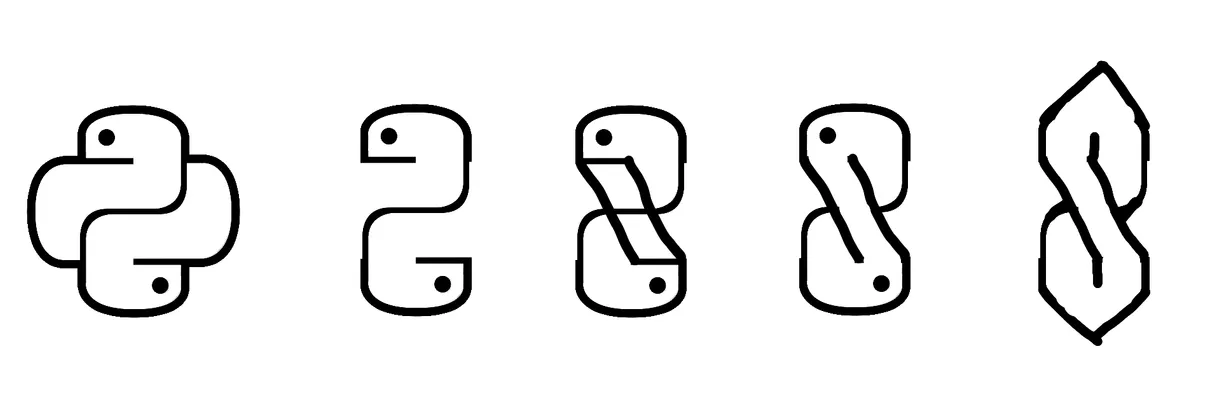
Suggestion
What if we did Project Euler on this?